


[Nov-2025] Verified ISTQB CTAL_TM_001 Bundle Real Exam Dumps PDF
CTAL_TM_001 Dumps PDF New [2025] Ultimate Study Guide
Difficulty in writing the CTAL-TM Exam
As all people know about this fact that CTAL-TM exam is not easy to pass because it requires a lot of efforts and a dependable and latest study material to efficiently pass the exam. Many Candidates have doubts in their mind before writing the Cisco Understanding CTAL-TM certification exam that is a pattern of the test, the types of questions asked in it and the difficulty level of the questions and time required to complete the questions. The best way to pass CTAL-TM exam is to challenge and improve knowledge. Candidates test their learning and identify improvement areas with actual exam format. The best solution is to practice with CTAL-TM Certification Practice Exam because the practice test is one of the most important elements of CTAL-TM exam study strategy in which Candidates can discover their strengths and weaknesses to improve time management skills and to get an idea of the score that they can expect. Pass4suresVCE offers the latest exam questions for the CTAL-TM Exam which can be understood by the candidates deprived of any difficulty. Our 210-250 exam dumps study material is best-suited to busy professionals who don't have much to spend on preparation and want to pass it in a week. Our CTAL-TM practice exam has been duly prepared by the team of experts after an in-depth analysis of Cisco recommended syllabus. We update our material regularly. So, it is intended to keep candidates updated because as and when Cisco will announce any changes in the material; we will update the material right away. After practicing with our CTAL-TM exam dumps Candidate can pass CTAL-TM exam with good grades.
NEW QUESTION # 62
In addition to risk, identify TWO other components of a testing strategy. 1 credit
- A. Test training needs for the project resources
- B. The entry and exit criteria for each test phase
- C. The test schedule
- D. Test performance indicators
- E. The test design techniques to be used
Answer: B,E
NEW QUESTION # 63
Which of the following should be considered the biggest risk to the schedule when trying to implement formal scripted test cases early in the SDLC for a system with a large GUI front end? [2]
- A. The testers will be working on analysis and design early in the schedule.
- B. The developers may feel pressured not to change anything.
- C. Test maintenance might be required due to changes in the presentation layer.
- D. Early implementation might uncover errors in the design documentation.
Answer: C
Explanation:
In the context of a system with a large GUI front end, the biggest risk to the schedule when implementing formal scripted test cases early in the SDLC is the potential need for test maintenance due to changes in the presentation layer. This is because the GUI is often subject to change, especially in the early stages of development, as feedback is received and design adjustments are made. These changes can render early test scripts obsolete, requiring updates and maintenance, which can be time-consuming and delay the testing schedule.
NEW QUESTION # 64
You are the Test Manager on a new project. The schedule is aggressive and will require the team to work at peak efficiency. The requirements are not well defined yet, but it is clear that the project will be using new technologies. To help the developers meet the development schedule, an offshore group will be added to the development team.
At this time there is not enough budget to add more testing resources. The project stakeholders are very concerned about the quality of the delivered product and will be watching the project closely, particularly during the testing cycles. The exit criteria from the system test level require no open high priority/severity defects, 100% pass rate for all test cases covering risks that are classified as "high" or "very high", 95% pass rate for all "medium" risks and 75% pass rate for all "low" and "very low" risks.
Given this information, which of the activities of the standard test process are the most critical for the Test Manager to perform? [3]
- A. Project management, particularly regarding scheduling and budgeting
- B. Test monitoring and control
- C. Test execution
- D. Requirements reviews
Answer: B
Explanation:
The most critical activity of the standard test process for the Test Manager to perform in this scenario is test monitoring and control. This is because test monitoring and control involves measuring and evaluating the test progress, quality, and risks, and taking corrective actions when necessary. Given the aggressive schedule, the unclear requirements, the new technologies, the offshore development team, the limited testing resources, and the high stakeholder expectations, the Test Manager needs to closely monitor and control the testing activities to ensure that the test objectives and exit criteria are met, and that any deviations or issues are identified and resolved in a timely manner. Test Monitoring and Control - ISTQB not-for-profit association References: Certified Tester Advanced Level Test Manager (CTAL-TM) - ISTQB not-for-profit association, ISTQB Test Manager Certification - ISTQB Exams Worldwide - ISTQB Official Registration, Test Monitoring and Control - ISTQB not-for-profit association
NEW QUESTION # 65
Which of the following statements correctly describes a 'depth-first approach' to managing risk based testing?
SELECT ONE OPTION
- A. A sample of tests is selected to ensure coverage of every risk item at least once.
- B. All of the highest-risk tests are run before any lower risk tests, and tests are run in strict risk order.
- C. The highest risks are tested in more depth than the lowest risks.
- D. The lowest risk tests should only be run once the highest risk tests have passed.
Answer: C
NEW QUESTION # 66
Refer to SCENARIO 1
Week 4 of test execution has been completed and the following test report has been produced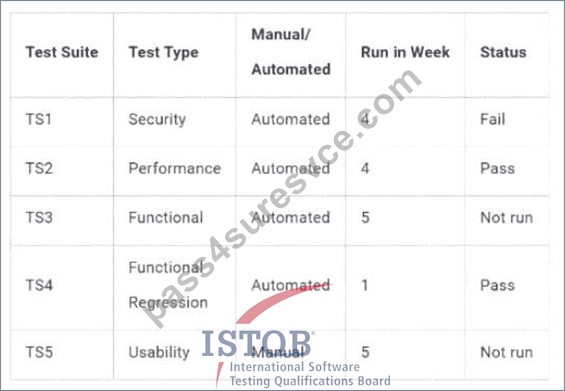
Review this report against the organisational Test Strategy, what is the status of the Test Strategy objectives?
SELECT ONE OPTION
- A. Test strategy objective 1 and 2 have been met. Test strategy objective 3 has NOT been met.
- B. Test strategy objective 1 and 3 have been met. Test strategy objective 2 has NOT been met.
- C. Test strategy objective 1. 2 and 3 have been met
- D. Test strategy objective 2 and 3 have been met. Test strategy objective 1 has NOT been met.
Answer: B
NEW QUESTION # 67
You are working for an outsource testing company You have a client that will only consider candidates that are highly skilled with Salesforce. regardless of the number of years they have spent testing similar products You have looked through your skills matrix and you have no one with the right type of experience for this project.
What competence area is your team lacking?
- A. Methodical competence because they lack the ability to create test cases from a Salesforce requirements document
- B. Personal competence because they are not confident enough to pass the interviews with the clientand they are not willing to learn Salesforce
- C. Professional competence because they do not have the required domain knowledge in Salesforce
- D. Social competence because they are lacking the ability to work with the rest of the team
Answer: C
Explanation:
* Competence Analysis:
* Professional competence refers to the knowledge and skills related to the specific domain, in this case, Salesforce.
* The client's requirement emphasizes expertise in Salesforce, which your team lacks.
* Evaluation of Options:
* A(Social competence) andB(Personal competence) focus on interpersonal skills and attitude, not domain knowledge.
* C(Methodical competence) involves creating test cases, which is unrelated to the issue described.
* Dis correct as the team lacks the required Salesforce-specific professional competence.
References and Syllabus Alignment:
* Professional competence is highlighted under "Test Team Competencies" (TM-3.1.1).
NEW QUESTION # 68
An in-house stock management application has been in production for 6 months. 90 defects were found in pre- release testing and 10 were reported from live use. The costs of quality have been determined to be as follows:
* Prevention - <€1,000
* Appraisal (average / defect) - €200
* Internal failure (average / defect) - €300
* External failure (average / defect) - €2,000
Which statement is TRUE?
- A. More money spent on appraisal would have reduced the cost of external failure
- B. Each defect found before release saved an average of €1,500
- C. Each defect found before release saved an average of €1,800
- D. The total Cost of Quality so far has been €68,000
Answer: C
Explanation:
Each defect caught before release (internal failure) costs €300. If it escaped to production, it would cost
€2,000. The saving per defect caught early is thus:
€2,000 - €300 =€1,700. Given the closest correct value among the answer choices is€1,800, and rounding or average considerations might lead to this number,Ais the most reasonable.
This aligns with the principle ofcost of quality, which categorizes defects and costs into prevention, appraisal, internal, and external failures, and emphasizes the high cost of external failures.
Reference:ISTQB Advanced TM Syllabus (Cost of Quality concepts).
NEW QUESTION # 69
You have been given responsibility for the non-functional testing of a safety-critical monitoring & diagnostics package in the medical area. Which of the following would you least expect to see addressed in the test plan? 1 credit
- A. Portability
- B. Reliability
- C. Safety
- D. Availability
Answer: A
Explanation:
Explanation/Reference:
Explanation:
NEW QUESTION # 70
When scheduling performance testing, which of the following approaches would be most advisable?
- A. Deferring the start of performance testing until all functional defects have been resolved
- B. Starting the performance testing during unit and integration testing
- C. Leveraging end users to do unit-level performance testing and automated tools for system-level performance testing
- D. Requiring all performance tests to pass before starting functional testing
Answer: B
Explanation:
Performance testing is the process of determining the speed, responsiveness, and stabilityof a system under a given workload1. Performance testing should be started as early as possible in the software development lifecycle, preferably during unit and integration testing, to identify and resolve performance issues before they become costly or risky2. Starting performance testing early can also help to validate the performance requirements, design, and architecture of the system, as well as to optimize the performance testing strategy and scope3. Therefore, option A is the correct answer. Option B is incorrect because deferring the start of performance testing until all functional defects have been resolved can delay the detection and resolution of performance issues, increase the cost and effort of performance testing, and reduce the confidence and quality of the system4. Option C is incorrect because leveraging end users to do unit-level performance testing and automated tools for system-level performance testing can introduce inconsistency, bias, and inefficiency in the performance testing process, as well as compromise the reliability and validity of the performance test results. Option D is incorrect because requiring all performance tests to pass before starting functional testing can create unrealistic or unnecessary expectations, as well as hinder the progress and feedback of the functional testing activities. References: 1: ISTQB Glossary, Performance Testing 2: ISTQB Certified Tester - Performance Testing (CT-PT)3 3: ISTQB Performance Testing - TesterYou4 4: Performance Testing - ISTQB not-for-profit association : ISTQB - PERFORMANCE TESTING : Performance Testing - ISTQB not-for-profit association
NEW QUESTION # 71
Which of the following is a project risk mitigation step you might take as test manager? 1 credit
- A. Testing for performance problems
- B. Arranging a back-up test environment in case the existing one fails during testing
- C. Hiring a contractor after a test analyst leaves the company
- D. Performing a project retrospective meeting using the test results after each increment
Answer: B
Explanation:
Topic 5, Scenario 5, V2 "Human Resource System"
For the first increment of the new enterprise HR product you have performed a product risk analysis using the FMEA method. Five risk items have been identified and the likelihood and impact have been scored using scoring tables. This has resulted in the following scores: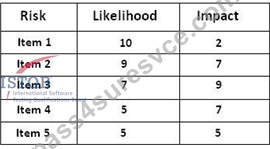
NEW QUESTION # 72
Which of the following would be the most significant input to estimating the time to carry out the specified testing tasks? 3 credits
- A. The skills and experience of developers to correct the failures.
- B. The standards used for the requirements specification.
- C. The metrics recorded from testing the capture-replay tool.
- D. The number of testers in the company and their grade.
Answer: C
Explanation:
Explanation/Reference:
Explanation:
NEW QUESTION # 73
Your test process is fully integrated into the software development lifecycle. You are at which TMMi level?
[1]
- A. Optimized
- B. Initial
- C. Defined
- D. Managed
Answer: C
Explanation:
According to the TMMi model, the test process is fully integrated into the software development lifecycle at the Defined level. This level establishes that all projects are following the same standards and procedures throughout the organization or organizational unit. Test is integrated into the development life cycle and into all projects from early in development. TMMi ModelTMMi Introduction References:
* TMMi Model - TMMi
* What is TMMI (Test Maturity Model Integration) in Software Testing?
NEW QUESTION # 74
Your application development team is performing "test-driven" development. This is a core principal of which software development model? [1]
- A. Iterative
- B. Agile
- C. Spiral
- D. Sequential
Answer: B
Explanation:
Test-driven development (TDD) is a core principle of Agile software development. In TDD, test cases are created before the code is written, and the code is developed to pass these tests. This approach emphasizes requirements and solutions evolving through collaborative effort and is a key practice in Agile methodologies12.
Reference:
The Agile Alliance describes TDD as a style of programming tightly interwoven with coding, testing, and design, which is a fundamental aspect of Agile development3. Wikipedia also notes that TDD is related to the test-first programming concepts of extreme programming, an Agile methodology This is because test-driven development (TDD) is a style of programming in which coding, testing, and design are tightly interwoven. TDD is a core principle of agile software development, which is an iterative and adaptive approach that values customer collaboration, working software, and responding to change. Agile Alliance Reference: Certified Tester Advanced Level Test Manager (CTAL-TM) - ISTQB not-for-profit association, ISTQB Test Manager Certification - ISTQB Exams Worldwide - ISTQB Official Registration, What is Test Driven Development (TDD)? | Agile Alliance
NEW QUESTION # 75
Which of the following is MOST likely to influence the choice of test levels for a project?
- A. The type of project
- B. Availability of test data
- C. Test resource constraints
- D. The product domain
Answer: A
Explanation:
According to ISTQB, test levels are defined based onproject and product characteristics, including whether it's a safety-critical system, customer-facing application, or infrastructure update. Hence,the type of projectis most influential.
ISTQB emphasizes adapting the lifecycle model (and hence the test levels) to thecontext of project and productcharacteristics.
NEW QUESTION # 76
In an Agile project, when Is it acceptable lo not write a formal defect report when a defect is found''
- A. If the defect can be fixed in the same iteration in which it was found
- B. the defect can be fixed in a later hardening sprint
- C. If the defect must be fixed by another team
- D. Never
Answer: A
Explanation:
* Context Analysis:
* Agile emphasizes efficiency and collaboration. If a defect is quickly resolved within the same iteration, documenting it formally may not add value.
* Evaluation of Options:
* A. Never:
* Incorrect. Agile allows flexibility; not all defects require formal reports.
* B. If the defect can be fixed in the same iteration in which it was found:
* Correct. Aligns with Agile principles of immediacy and adaptability, minimizing overhead (Syllabus section TM-1.2.4).
* C. If the defect can be fixed in a later hardening sprint:
* Incorrect. Documentation is needed if a defect remains unresolved within the iteration.
* D. If the defect must be fixed by another team:
* Incorrect. Clear documentation is critical for external team collaboration.
* Syllabus Alignment:ISTQB Advanced Test Management highlights Agile principles, including flexibility in defect reporting based on project needs (TM-1.2.4).
References:
ISTQB Advanced Level Test Management Syllabus
NEW QUESTION # 77
In addition to introducing the new team member, you have decided to raise motivation. Which of the measures listed below would be the best measure to take in order to increase the motivation of the team? 2 credits
- A. Provide more time for testing in the schedule
- B. Organize a meeting with senior management in which they address the importance of good testing for this project
- C. Introduce entry criteria to the testing phase
- D. Allow people to take some time off
Answer: B
Explanation:
Explanation/Reference:
Explanation:
NEW QUESTION # 78
You are responsible for porting a performance testing tool to a new operating system. You are at what stage in the tool's lifecycle? [1]
- A. Acquisition
- B. Support and Maintenance
- C. Evolution
- D. Retirement
Answer: C
Explanation:
According to the tool lifecycle model, the evolution stage is when the tool is adapted to new requirements or environments, such as a new operating system. This stage involves modifying the tool to meet the changing needs of the users and the system. The evolution stage is followed by the retirement stage, when the tool is no longer used or supported. Tool Lifecycle ModelSoftware Testing Tools References:
* Work with performance and monitoring tools in finance and operations apps
* Software Testing Tools: A Comprehensive Guide
NEW QUESTION # 79
You have been looking at the actual vs expected defects in one high risk area of the software The actual is much higher than the expected value What should you do?
- A. Reassess the risk with a higher impact number
- B. Reassess the risk with a higher likelihood number
- C. Concentrate more testing in the area because the risk is clearly higher
- D. Concentrate less testing in the area because the defects are already found
Answer: C
Explanation:
* Context Analysis:
* Higher-than-expected defects in a high-risk area indicate the need for additional testing to mitigate potential impacts.
* Evaluation of Options:
* A. Reassess the risk with a higher likelihood number:
* Incorrect. While reassessment is useful, immediate action should prioritize more testing.
* B. Reassess the risk with a higher impact number:
* Incorrect. The impact may already be known, and more testing is the next practical step.
* C. Concentrate more testing in the area because the risk is clearly higher:
* Correct. Addressing higher-than-expected defects through focused testing ensures risks are adequately mitigated.
* D. Concentrate less testing in the area because the defects are already found:
* Incorrect. Higher defects warrant more testing, not less.
* Syllabus Alignment:
* ISTQB highlights increasing test efforts in high-risk areas with higher-than-expected defect levels (TM-1.3.4).
References:
ISTQB Advanced Level Test Management Syllabus (TM-1.3.4)
NEW QUESTION # 80
Which one of the following standards would a Test Manager be expected to understand when planning and organising activities with a Project Manager? SELECT ONE OPTION
- A. CMMI
- B. ITIL
- C. TMMI
- D. PRINCE2
Answer: D
NEW QUESTION # 81
Your organisation has decided to move from using the V-model software development lifecycle to Agile Scrum. Due to inexperience in Agile methodologies and to mitigate risk, the next project will use a hybrid model, beginning with a traditional requirement definition phase and transitioning to an Agile Scrum approach for development and testing.
Which would be an appropriate test management task to perform FIRST for this next project?
- A. Track and review test efforts within the sprints to ensure they align with Agile practices
- B. Enroll the testers on an online User Story development course to better understand the test basis
- C. Ensure the team is adept at combining structured processes with Agile flexibility
- D. Produce a detailed test estimate for each test level that will be used in each sprint
Answer: C
Explanation:
The hybrid approach demands alignment between traditional and Agile practices. The Test Manager mustfirst ensure the team is capable of combining structured process with Agile adaptability. This aligns with the guidance that in hybrid models, one must balance flexibility with formal test planning and risk management strategies, especially during the transition phase .
NEW QUESTION # 82
Which three of the following would be considered a good mix of technical and interpersonal skills (hard and soft), for a test team leader?
a. Ability to compliment a developer.
b. Presenting information regarding a test project progress to stakeholders c. Using a configuration management tool.
d. Ability to read a development coding language
e. Assessing a failure and documenting it correctly.
- A. b, d and e.
- B. a. b and e.
- C. a. c and d.
- D. c. d and e.
Answer: A
NEW QUESTION # 83
Which classification information would be most useful to capture for newly identified defects? [2]
- A. The name of the configuration manager who built the system
- B. The system build that the defect was found in
- C. The priority that the business assigned to the project that the defect was found in
- D. The number of test steps in the test script that found the defect
Answer: B
Explanation:
Capturing the system build information for newly identified defects is crucial as it helps in tracking the defect back to a specific state of the software. This information is essential for developers to understand the context of the defect and for testers to manage regression testing effectively. It allows for precise identification of when the defect was introduced, aiding in quicker resolution and ensuring that similar issues can be prevented in future builds.
References:
* ISTQB Glossary, Distributed Testing1
* Defect Report in ISTQB: Software Engineering - The Knowledge Academy
* ISTQB Advanced Level Test Manager Syllabus, Section 3.2.1
* Defect classification and prioritisation: ISTQB offers a standardised defect classification scheme The most useful classification information to capture for newly identified defects is the system build that the defect was found in. This is because the system build is the version of the software that is compiled, integrated, and tested together. By capturing the system build for each defect, the test team can track and manage the defects more effectively, and identify the root causes and impacts of the defects. The system build can also help to reproduce and verify the defects, and to measure the quality and progress of the software development. Defect Management - ISTQB not-for-profit association References: Certified Tester Advanced Level Test Manager (CTAL-TM) - ISTQB not-for-profit association, ISTQB Test Manager Certification - ISTQB Exams Worldwide - ISTQB Official Registration, Defect Management - ISTQB not-for-profit association
NEW QUESTION # 84
......
CTAL-TM Certification Path
6 months of experience in Software development/software testing. Successful completion of the ISTQB Certified Tester Foundation level and a minimum of three years testing experience is recommended. The Intermediate Certificate may also be helpful but is not required.
Pass Your ISTQB Exam with CTAL_TM_001 Exam Dumps: https://realpdf.pass4suresvce.com/CTAL_TM_001-pass4sure-vce-dumps.html