


2024 Latest 100% Exam Passing Ratio - CAS-005 Dumps PDF
Pass Exam With Full Sureness - CAS-005 Dumps with 120 Questions
NEW QUESTION # 54
A company's help desk is experiencing a large number of calls from the finance department slating access issues to www bank com The security operations center reviewed the following security logs:
Which of the following is most likely the cause of the issue?
- A. The DNS was set up incorrectly.
- B. The DNS record has been poisoned.
- C. Recursive DNS resolution is failing
- D. DNS traffic is being sinkholed.
Answer: D
Explanation:
Sinkholing, or DNS sinkholing, is a method used to redirect malicious traffic to a safe destination. This technique is often employed by security teams to prevent access to malicious domains by substituting a benign destination IP address.
In the given logs, users from the finance department are accessing www.bank.com and receiving HTTP status code 495. This status code is typically indicative of a client certificate error, which can occur if the DNS traffic is being manipulated or redirected incorrectly. The consistency in receiving the same HTTP status code across different users suggests a systematic issue rather than an isolated incident.
* Recursive DNS resolution failure (A) would generally lead to inability to resolve DNS at all, not to a specific HTTP error.
* DNS poisoning (B) could result in users being directed to malicious sites, but again, would likely result in a different set of errors or unusual activity.
* Incorrect DNS setup (D) would likely cause broader resolution issues rather than targeted errors like the one seen here.
By reviewing the provided data, it is evident that the DNS traffic for www.bank.com is being rerouted improperly, resulting in consistent HTTP 495 errors for the finance department users. Hence, the most likely cause is that the DNS traffic is being sinkholed.
References:
* CompTIA SecurityX study materials on DNS security mechanisms.
* Standard HTTP status codes and their implications.
NEW QUESTION # 55
A company that uses containers to run its applications is required to identify vulnerabilities on every container image in a private repository The security team needs to be able to quickly evaluate whether to respond to a given vulnerability Which of the following, will allow the security team to achieve the objective with the last effort?
- A. SAST scan reports
- B. Credentialed vulnerability scan
- C. Centralized SBoM
- D. CIS benchmark compliance reports
Answer: C
Explanation:
A centralized Software Bill of Materials (SBoM) is the best solution for identifying vulnerabilities in container images in a private repository. An SBoM provides a comprehensive inventory of all components, dependencies, and their versions within a container image, facilitating quick evaluation and response to vulnerabilities.
Why Centralized SBoM?
* Comprehensive Inventory: An SBoM lists all software components, including their versions and dependencies, allowing for thorough vulnerability assessments.
* Quick Identification: Centralizing SBoM data enables rapid identification of affected containers when a vulnerability is disclosed.
* Automation: SBoMs can be integrated into automated tools for continuous monitoring and alerting of vulnerabilities.
* Regulatory Compliance: Helps in meeting compliance requirements by providing a clear and auditable record of all software components used.
Other options, while useful, do not provide the same level of comprehensive and efficient vulnerability management:
* A. SAST scan reports: Focuses on static analysis of code but may not cover all components in container images.
* C. CIS benchmark compliance reports: Ensures compliance with security benchmarks but does not provide detailed component inventory.
* D. Credentialed vulnerability scan: Useful for in-depth scans but may not be as efficient for quick vulnerability evaluation.
References:
* CompTIA SecurityX Study Guide
* "Software Bill of Materials (SBoM)," NIST Documentation
* "Managing Container Security with SBoM," OWASP
NEW QUESTION # 56
A security analyst needs to ensure email domains that send phishing attempts without previous communications are not delivered to mailboxes The following email headers are being reviewed
Which of the following is the best action for the security analyst to take?
- A. Block messages from hr-saas.com because it is not a recognized domain.
- B. Reroute all messages with unusual security warning notices to the IT administrator
- C. Block vendor com for repeated attempts to send suspicious messages
- D. Quarantine all messages with sales-mail.com in the email header
Answer: C
Explanation:
In reviewing email headers and determining actions to mitigate phishing attempts, the security analyst should focus on patterns of suspicious behavior and the reputation of the sending domains. Here's the analysis of the options provided:
A; Block messages from hr-saas.com because it is not a recognized domain: Blocking a domain solely because it is not recognized can lead to legitimate emails being missed. Recognition alone should not be the criterion for blocking.
B: Reroute all messages with unusual security warning notices to the IT administrator: While rerouting suspicious messages can be a good practice, it is not specific to the domain sending repeated suspicious messages.
C: Quarantine all messages with sales-mail.com in the email header: Quarantining messages based on the presence of a specific domain in the email header can be too broad and may capture legitimate emails.
D: Block vendor com for repeated attempts to send suspicious messages: This option is the most appropriate because it targets a domain that has shown a pattern of sending suspicious messages. Blocking a domain that repeatedly sends phishing attempts without previous communications helps in preventing future attempts from the same source and aligns with the goal of mitigating phishing risks.
References:
* CompTIA SecurityX Study Guide: Details best practices for handling phishing attempts, including blocking domains with repeated suspicious activity.
* NIST Special Publication 800-45 Version 2, "Guidelines on Electronic Mail Security": Provides guidelines on email security, including the management of suspicious email domains.
* "Phishing and Countermeasures: Understanding the Increasing Problem of Electronic Identity Theft" by Markus Jakobsson and Steven Myers: Discusses effective measures to counter phishing attempts, including blocking persistent offenders.
By blocking the domain that has consistently attempted to send suspicious messages, the security analyst can effectively reduce the risk of phishing attacks.
NEW QUESTION # 57
A security analyst received a report that an internal web page is down after a company-wide update to the web browser Given the following error message:
Which of the following is the best way to fix this issue?
- A. Discontinuing the use of self-signed certificates
- B. Rewriting any legacy web functions
- C. Disabling all deprecated ciphers
- D. Blocking all non-essential pons
Answer: A
Explanation:
The error message "NET::ERR_CERT_WEAK_SIGNATURE_ALGORITHM" indicates that the web browser is rejecting the certificate because it uses a weak signature algorithm. This commonly happens with self-signed certificates, which often use outdated or insecure algorithms.
Why Discontinue Self-Signed Certificates?
* Security Compliance: Modern browsers enforce strict security standards and may reject certificates that do not comply with these standards.
* Trusted Certificates: Using certificates from a trusted Certificate Authority (CA) ensures compliance with security standards and is less likely to be flagged as insecure.
* Weak Signature Algorithm: Self-signed certificates might use weak algorithms like MD5 or SHA-1, which are considered insecure.
Other options do not address the specific cause of the certificate error:
* A. Rewriting legacy web functions: Does not address the certificate issue.
* B. Disabling deprecated ciphers: Useful for improving security but not related to the certificate error.
* C. Blocking non-essential ports: This is unrelated to the issue of certificate validation.
References:
* CompTIA SecurityX Study Guide
* "Managing SSL/TLS Certificates," OWASP
* "Best Practices for Certificate Management," NIST Special Publication 800-57
NEW QUESTION # 58
A systems administrator wants to reduce the number of failed patch deployments in an organization. The administrator discovers that system owners modify systems or applications in an ad hoc manner. Which of the following is the best way to reduce the number of failed patch deployments?
- A. Situational awareness
- B. Compliance tracking
- C. Change management
- D. Quality assurance
Answer: C
Explanation:
To reduce the number of failed patch deployments, the systems administrator should implement a robust change management process. Change management ensures that all modifications to systems or applications are planned, tested, and approved before deployment. This systematic approach reduces the risk of unplanned changes that can cause patch failures and ensures that patches are deployed in a controlled and predictable manner.
References:
* CompTIA SecurityX Study Guide: Emphasizes the importance of change management in maintaining system integrity and ensuring successful patch deployments.
* ITIL (Information Technology Infrastructure Library) Framework: Provides best practices for change management in IT services.
* "The Phoenix Project" by Gene Kim, Kevin Behr, and George Spafford: Discusses the critical role of change management in IT operations and its impact on system stability and reliability.
NEW QUESTION # 59
You are a security analyst tasked with interpreting an Nmap scan output from company's privileged network.
The company's hardening guidelines indicate the following:
There should be one primary server or service per device.
Only default ports should be used.
Non-secure protocols should be disabled.
INSTRUCTIONS
Using the Nmap output, identify the devices on the network and their roles, and any open ports that should be closed.
For each device found by Nmap, add a device entry to the Devices Discovered list, with the following information:
The IP address of the device
The primary server or service of the device (Note that each IP should by associated with one service/port only) The protocol(s) that should be disabled based on the hardening guidelines (Note that multiple ports may need to be closed to comply with the hardening guidelines) If at any time you would like to bring back the initial state of the simulation, please click the Reset All button.

Answer:
Explanation:
See explanation below.
Explanation:
10.1.45.65 SFTP Server Disable 8080
10.1.45.66 Email Server Disable 415 and 443
10.1.45.67 Web Server Disable 21, 80
10.1.45.68 UTM Appliance Disable 21
NEW QUESTION # 60
An organization wants to implement a platform to better identify which specific assets are affected by a given vulnerability. Which of the following components provides the best foundation to achieve this goal?
- A. CMDB
- B. SBoM
- C. SASE
- D. SLM
Answer: A
Explanation:
A Configuration Management Database (CMDB) provides the best foundation for identifying which specific assets are affected by a given vulnerability. A CMDB maintains detailed information about the IT environment, including hardware, software, configurations, and relationships between assets. This comprehensive view allows organizations to quickly identify and address vulnerabilities affecting specific assets.
References:
* CompTIA SecurityX Study Guide: Discusses the role of CMDBs in asset management and vulnerability identification.
* ITIL (Information Technology Infrastructure Library) Framework: Recommends the use of CMDBs for effective configuration and asset management.
* "Configuration Management Best Practices" by Bob Aiello and Leslie Sachs: Covers the importance of
* CMDBs in managing IT assets and addressing vulnerabilities.
NEW QUESTION # 61
A software development team requires valid data for internal tests. Company regulations, however do not allow the use of this data in cleartext. Which of the following solutions best meet these requirements?
- A. Configuring data hashing
- B. Deploying tokenization
- C. Implementing data obfuscation
- D. Replacing data with null record
Answer: B
Explanation:
Tokenization replaces sensitive data elements with non-sensitive equivalents, called tokens, that can be used within the internal tests. The original data is stored securely and can be retrieved if necessary. This approach allows the software development team to work with data that appears realistic and valid without exposing the actual sensitive information.
Configuring data hashing (Option A) is not suitable for test data as it transforms the data into a fixed-length value that is not usable in the same way as the original data. Replacing data with null records (Option C) is not useful as it does not provide valid data for testing. Data obfuscation (Option D) could be an alternative but might not meet the regulatory requirements as effectively as tokenization.
References:
* CompTIA Security+ Study Guide
* NIST SP 800-57 Part 1 Rev. 5, "Recommendation for Key Management"
* PCI DSS Tokenization Guidelines
NEW QUESTION # 62
A security administrator needs to automate alerting. The server generates structured log files that need to be parsed to determine whether an alarm has been triggered Given the following code function:
Which of the following is most likely the log input that the code will parse?
- A.

- B.

- C.

- D.

Answer: B
Explanation:
The code function provided in the question seems to be designed to parse JSON formatted logs to check for an alarm state. Option A is a JSON format that matches the structure likely expected by the code. The presence of the "error_log" and "InAlarmState" keys suggests that this is the correct input format.
NEW QUESTION # 63
A company plans to implement a research facility with Intellectual property data that should be protected The following is the security diagram proposed by the security architect
Which of the following security architect models is illustrated by the diagram?
- A. Perimeter protection security model
- B. Zero Trust security model
- C. Identity and access management model
- D. Agent based security model
Answer: B
Explanation:
The security diagram proposed by the security architect depicts a Zero Trust security model. Zero Trust is a security framework that assumes all entities, both inside and outside the network, cannot be trusted and must be verified before gaining access to resources.
Key Characteristics of Zero Trust in the Diagram:
* Role-based Access Control: Ensures that users have access only to the resources necessary for their role.
* Mandatory Access Control: Additional layer of security requiring authentication for access to sensitive areas.
* Network Access Control: Ensures that devices meet security standards before accessing the network.
* Multi-factor Authentication (MFA): Enhances security by requiring multiple forms of verification.
This model aligns with the Zero Trust principles of never trusting and always verifying access requests, regardless of their origin.
References:
* CompTIA SecurityX Study Guide
* NIST Special Publication 800-207, "Zero Trust Architecture"
* "Implementing a Zero Trust Architecture," Forrester Research
NEW QUESTION # 64
A security analyst is troubleshooting the reason a specific user is having difficulty accessing company resources The analyst reviews the following information: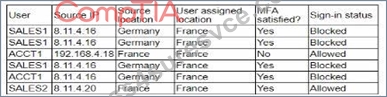
Which of the following is most likely the cause of the issue?
- A. Several users have not configured their mobile devices to receive OTP codes
- B. The local network access has been configured to bypass MFA requirements.
- C. Administrator access from an alternate location is blocked by company policy
- D. A network geolocation is being misidentified by the authentication server
Answer: D
Explanation:
The table shows that the user "SALES1" is consistently blocked despite having met the MFA requirements.
The common factor in these blocked attempts is the source IP address (8.11.4.16) being identified as from Germany while the user is assigned to France. This discrepancy suggests that the network geolocation is being misidentified by the authentication server, causing legitimate access attempts to be blocked.
Why Network Geolocation Misidentification?
* Geolocation Accuracy: Authentication systems often use IP geolocation to verify the location of access attempts. Incorrect geolocation data can lead to legitimate requests being denied if they appear to come from unexpected locations.
* Security Policies: Company security policies might block access attempts from certain locations to prevent unauthorized access. If the geolocation is wrong, legitimate users can be inadvertently blocked.
* Consistent Pattern: The user "SALES1" from the IP address 8.11.4.16 is always blocked, indicating a consistent issue with geolocation.
Other options do not align with the pattern observed:
* A. Bypass MFA requirements: MFA is satisfied, so bypassing MFA is not the issue.
* C. Administrator access policy: This is about user access, not specific administrator access.
* D. OTP codes: The user has satisfied MFA, so OTP code configuration is not the issue.
References:
* CompTIA SecurityX Study Guide
* "Geolocation and Authentication," NIST Special Publication 800-63B
* "IP Geolocation Accuracy," Cisco Documentation
NEW QUESTION # 65
A company updates its cloud-based services by saving infrastructure code in a remote repository. The code is automatically deployed into the development environment every time the code is saved lo the repository The developers express concern that the deployment often fails, citing minor code issues and occasional security control check failures in the development environment Which of the following should a security engineer recommend to reduce the deployment failures? (Select two).
- A. Repository branch protection
- B. Pre-commit code linting
- C. Software composition analysis
- D. Code submit authorization workflow
- E. Pipeline compliance scanning
- F. Automated regression testing
Answer: B,F
Explanation:
* B. Pre-commit code linting: Linting tools analyze code for syntax errors and adherence to coding standards before the code is committed to the repository. This helps catch minor code issues early in the development process, reducing the likelihood of deployment failures.
* D. Automated regression testing: Automated regression tests ensure that new code changes do not introduce bugs or regressions into the existing codebase. By running these tests automatically during the deployment process, developers can catch issues early and ensure the stability of the development environment.
Other options:
* A. Software composition analysis: This helps identify vulnerabilities in third-party components but does not directly address code quality or deployment failures.
* C. Repository branch protection: While this can help manage the code submission process, it does not directly prevent deployment failures caused by code issues or security check failures.
* E. Code submit authorization workflow: This manages who can submit code but does not address the quality of the code being submitted.
* F. Pipeline compliance scanning: This checks for compliance with security policies but does not address syntax or regression issues.
References:
* CompTIA Security+ Study Guide
* "Continuous Integration and Continuous Delivery" by Jez Humble and David Farley
* OWASP (Open Web Application Security Project) guidelines on secure coding practices
NEW QUESTION # 66
Third parties notified a company's security team about vulnerabilities in the company's application. The security team determined these vulnerabilities were previously disclosed in third-party libraries. Which of the following solutions best addresses the reported vulnerabilities?
- A. Using laC to include the newest dependencies
- B. Creating a bug bounty program
- C. Integrating a SASI tool as part of the pipeline
- D. Implementing a continuous security assessment program
Answer: C
Explanation:
The best solution to address reported vulnerabilities in third-party libraries is integrating a Static Application Security Testing (SAST) tool as part of the development pipeline. Here's why:
* Early Detection: SAST tools analyze source code for vulnerabilities before the code is compiled. This allows developers to identify and fix security issues early in the development process.
* Continuous Security: By integrating SAST tools into the CI/CD pipeline, the organization ensures continuous security assessment of the codebase, including third-party libraries, with each code commit and build.
* Comprehensive Analysis: SAST tools provide a detailed analysis of the code, identifying potential vulnerabilities in both proprietary code and third-party dependencies, ensuring that known issues in libraries are addressed promptly.
* References:
* CompTIA Security+ SY0-601 Study Guide by Mike Chapple and David Seidl
* OWASP Static Analysis Security Testing (SAST) Cheat Sheet
* NIST Special Publication 800-53: Security and Privacy Controls for Information Systems and Organizations
NEW QUESTION # 67
An engineering team determines the cost to mitigate certain risks is higher than the asset values The team must ensure the risks are prioritized appropriately. Which of the following is the best way to address the issue?
- A. Purchasing insurance
- B. Vulnerability assessments
- C. Branch protection
- D. Data labeling
Answer: A
Explanation:
When the cost to mitigate certain risks is higher than the asset values, the best approach is to purchase insurance. This method allows the company to transfer the risk to an insurance provider, ensuring that financial losses are covered in the event of an incident. This approach is cost-effective and ensures that risks are prioritized appropriately without overspending on mitigation efforts.
References:
* CompTIA SecurityX Study Guide: Discusses risk management strategies, including risk transfer through insurance.
* NIST Risk Management Framework (RMF): Highlights the use of insurance as a risk mitigation strategy.
* "Information Security Risk Assessment Toolkit" by Mark Talabis and Jason Martin: Covers risk management practices, including the benefits of purchasing insurance.
NEW QUESTION # 68
A security configure is building a solution to disable weak CBC configuration for remote access connections lo Linux systems. Which of the following should the security engineer modify?
- A. The /etc/nsswith.conf file, updating the name server
- B. The /etc/hosts file, updating the IP parameter
- C. The /etc/openssl.conf file, updating the virtual site parameter
- D. The /etc/etc/sshd, configure file updating the ciphers
Answer: D
Explanation:
The sshd_config file is the main configuration file for the OpenSSH server. To disable weak CBC (Cipher Block Chaining) ciphers for SSH connections, the security engineer should modify the sshd_config file to update the list of allowed ciphers. This file typically contains settings for the SSH daemon, including which encryption algorithms are allowed.
By editing the /etc/ssh/sshd_config file and updating the Ciphers directive, weak ciphers can be removed, and only strong ciphers can be allowed. This change ensures that the SSH server does not use insecure encryption methods.
References:
* CompTIA Security+ Study Guide
* OpenSSH manual pages (man sshd_config)
* CIS Benchmarks for Linux
NEW QUESTION # 69
During a security assessment using an CDR solution, a security engineer generates the following report about the assets in me system:
After five days, the EDR console reports an infection on the host 0WIN23 by a remote access Trojan Which of the following is the most probable cause of the infection?
- A. 0W1N29 spreads the malware through other hosts in the network
- B. LN002 was not supported by the EDR solution and propagates the RAT
- C. OW1N23 uses a legacy version of Windows that is not supported by the EDR
- D. The EDR has an unknown vulnerability that was exploited by the attacker.
Answer: C
Explanation:
OWIN23 is running Windows 7, which is a legacy operating system. Many EDR solutions no longer provide full support for outdated operating systems like Windows 7, which has reached its end of life and is no longer receiving security updates from Microsoft. This makes such systems more vulnerable to infections and attacks, including remote access Trojans (RATs).
* A. OWIN23 uses a legacy version of Windows that is not supported by the EDR: This is the most probable cause because the lack of support means that the EDR solution may not fully protect or monitor this system, making it an easy target for infections.
* B. LN002 was not supported by the EDR solution and propagates the RAT: While LN002 is unmanaged, it is less likely to propagate the RAT to OWIN23 directly without an established vector.
* C. The EDR has an unknown vulnerability that was exploited by the attacker: This is possible but less likely than the lack of support for an outdated OS.
* D. OWIN29 spreads the malware through other hosts in the network: While this could happen, the status indicates OWIN29 is in a bypass mode, which might limit its interactions but does not directly explain the infection on OWIN23.
References:
* CompTIA Security+ Study Guide
* NIST SP 800-53, "Security and Privacy Controls for Information Systems and Organizations"
* Microsoft's Windows 7 End of Support documentation
NEW QUESTION # 70
During a gap assessment, an organization notes that OYOD usage is a significant risk. The organization implemented administrative policies prohibiting BYOD usage However, the organization has not implemented technical controls to prevent the unauthorized use of BYOD assets when accessing the organization's resources. Which of the following solutions should the organization implement to best reduce the risk of OYOD devices? (Select two).
- A. Conditional access, to enforce user-to-device binding
- B. Cloud 1AM to enforce the use of token based MFA
- C. DLP, to enforce data protection capabilities
- D. NAC, to enforce device configuration requirements
- E. SD-WAN. to enforce web content filtering through external proxies
- F. PAM. to enforce local password policies
Answer: A,D
Explanation:
To reduce the risk of unauthorized BYOD (Bring Your Own Device) usage, the organization should implement Conditional Access and Network Access Control (NAC).
Why Conditional Access and NAC?
* Conditional Access:
* User-to-Device Binding: Conditional access policies can enforce that only registered and compliant devices are allowed to access corporate resources.
* Context-Aware Security: Enforces access controls based on the context of the access attempt, such as user identity, device compliance, location, and more.
* Network Access Control (NAC):
* Device Configuration Requirements: NAC ensures that only devices meeting specific security configurations are allowed to connect to the network.
* Access Control: Provides granular control over network access, ensuring that BYOD devices comply with security policies before gaining access.
Other options, while useful, do not address the specific need to control and secure BYOD devices effectively:
* A. Cloud IAM to enforce token-based MFA: Enhances authentication security but does not control device compliance.
* D. PAM to enforce local password policies: Focuses on privileged account management, not BYOD control.
* E. SD-WAN to enforce web content filtering: Enhances network performance and security but does not enforce BYOD device compliance.
* F. DLP to enforce data protection capabilities: Protects data but does not control BYOD device access and compliance.
References:
* CompTIA SecurityX Study Guide
* "Conditional Access Policies," Microsoft Documentation
* "Network Access Control (NAC)," Cisco Documentation
NEW QUESTION # 71
A network engineer must ensure that always-on VPN access is enabled Curt restricted to company assets Which of the following best describes what the engineer needs to do''
- A. Create a wildcard certificate for connections from public networks
- B. Generate device certificates using the specific template settings needed
- C. Modify signing certificates in order to support IKE version 2
- D. Add the VPN hostname as a SAN entry on the root certificate
Answer: B
Explanation:
To ensure always-on VPN access is enabled and restricted to company assets, the network engineer needs to generate device certificates using the specific template settings required for the company's VPN solution.
These certificates ensure that only authorized devices can establish a VPN connection.
Why Device Certificates are Necessary:
* Authentication: Device certificates authenticate company assets, ensuring that only authorized devices can access the VPN.
* Security: Certificates provide a higher level of security compared to username and password combinations, reducing the risk of unauthorized access.
* Compliance: Certificates help in meeting security policies and compliance requirements by ensuring that only managed devices can connect to the corporate network.
Other options do not provide the same level of control and security for always-on VPN access:
* B. Modify signing certificates for IKE version 2: While important for VPN protocols, it does not address device-specific authentication.
* C. Create a wildcard certificate: This is not suitable for device-specific authentication and could introduce security risks.
* D. Add the VPN hostname as a SAN entry: This is more related to certificate management and does not ensure device-specific authentication.
References:
* CompTIA SecurityX Study Guide
* "Device Certificates for VPN Access," Cisco Documentation
* NIST Special Publication 800-77, "Guide to IPsec VPNs"
NEW QUESTION # 72
A financial technology firm works collaboratively with business partners in the industry to share threat intelligence within a central platform This collaboration gives partner organizations the ability to obtain and share data associated with emerging threats from a variety of adversaries Which of the following should the organization most likely leverage to facilitate this activity? (Select two).
- A. ATTACK
- B. JTAG
- C. CWPP
- D. STIX
- E. TAXII
- F. YAKA
Answer: D,E
Explanation:
* D. STIX (Structured Threat Information eXpression): STIX is a standardized language for representing threat information in a structured and machine-readable format. It facilitates the sharing of threat intelligence by ensuring that data is consistent and can be easily understood by all parties involved.
* E. TAXII (Trusted Automated eXchange of Indicator Information): TAXII is a transport mechanism that enables the sharing of cyber threat information over a secure and trusted network. It works in conjunction with STIX to automate the exchange of threat intelligence among organizations.
Other options:
* A. CWPP (Cloud Workload Protection Platform): This focuses on securing cloud workloads and is not directly related to threat intelligence sharing.
* B. YARA: YARA is used for malware research and identifying patterns in files, but it is not a platform for sharing threat intelligence.
* C. ATT&CK: This is a knowledge base of adversary tactics and techniques but does not facilitate the sharing of threat intelligence data.
* F. JTAG: JTAG is a standard for testing and debugging integrated circuits, not related to threat intelligence.
References:
* CompTIA Security+ Study Guide
* "STIX and TAXII: The Backbone of Threat Intelligence Sharing" by MITRE
* NIST SP 800-150, "Guide to Cyber Threat Information Sharing"
NEW QUESTION # 73
An audit finding reveals that a legacy platform has not retained loos for more than 30 days The platform has been segmented due to its interoperability with newer technology. As a temporary solution, the IT department changed the log retention to 120 days. Which of the following should the security engineer do to ensure the logs are being properly retained?
- A. Configure a scheduled task nightly to save the logs
- B. Configure event-based triggers to export the logs at a threshold.
- C. Configure a Python script to move the logs into a SQL database.
- D. Configure the SIEM to aggregate the logs
Answer: D
Explanation:
To ensure that logs from a legacy platform are properly retained beyond the default retention period, configuring the SIEM to aggregate the logs is the best approach. SIEM solutions are designed to collect, aggregate, and store logs from various sources, providing centralized log management and retention. This setup ensures that logs are retained according to policy and can be easily accessed for analysis and compliance purposes.
References:
* CompTIA SecurityX Study Guide: Discusses the role of SIEM in log management and retention.
* NIST Special Publication 800-92, "Guide to Computer Security Log Management": Recommends the use of centralized log management solutions, such as SIEM, for effective log retention and analysis.
* "Security Information and Event Management (SIEM) Implementation" by David Miller: Covers best practices for configuring SIEM systems to aggregate and retain logs from various sources.
NEW QUESTION # 74 
Which of the following is the security engineer most likely doing?
- A. Reporting on remote log-in activities to track team metrics
- B. Threat hunting for suspicious activity from an insider threat
- C. Baselining user behavior to support advanced analytics
- D. Assessing log in activities using geolocation to tune impossible Travel rate alerts
Answer: D
Explanation:
In the given scenario, the security engineer is likely examining login activities and their associated geolocations. This type of analysis is aimed at identifying unusual login patterns that might indicate an impossible travel scenario. An impossible travel scenario is when a single user account logs in from geographically distant locations in a short time, which is physically impossible. By assessing login activities using geolocation, the engineer can tune alerts to identify and respond to potential security breaches more effectively.
NEW QUESTION # 75
A company wants to use loT devices to manage and monitor thermostats at all facilities The thermostats must receive vendor security updates and limit access to other devices within the organization Which of the following best addresses the company's requirements''
- A. Only allowing operation for loT devices during a specified time window
- B. Only allowing Internet access to a set of specific domains
- C. Configuring IoT devices to always allow automatic updates
- D. Operating lot devices on a separate network with no access to other devices internally
Answer: D
Explanation:
The best approach for managing and monitoring IoT devices, such as thermostats, is to operate them on a separate network with no access to other internal devices. This segmentation ensures that the IoT devices are isolated from the main network, reducing the risk of potential security breaches affecting other critical systems. Additionally, this setup allows for secure vendor updates without exposing the broader network to potential vulnerabilities inherent in IoT devices.
References:
* CompTIA SecurityX Study Guide: Recommends network segmentation for IoT devices to minimize security risks.
* NIST Special Publication 800-183, "Network of Things": Advises on the isolation of IoT devices to enhance security.
* "Practical IoT Security" by Brian Russell and Drew Van Duren: Discusses best practices for securing IoT devices, including network segmentation.
NEW QUESTION # 76
The material finding from a recent compliance audit indicate a company has an issue with excessive permissions. The findings show that employees changing roles or departments results in privilege creep.
Which of the following solutions are the best ways to mitigate this issue? (Select two).
Setting different access controls defined by business area
- A. Requiring periodic job rotation
- B. Designing a least-needed privilege policy
- C. Performing periodic access reviews
- D. Implementing a role-based access policy
- E. Establishing a mandatory vacation policy
Answer: C,D
Explanation:
To mitigate the issue of excessive permissions and privilege creep, the best solutions are:
* Implementing a Role-Based Access Policy:
* Role-Based Access Control (RBAC): This policy ensures that access permissions are granted based on the user's role within the organization, aligning with the principle of least privilege.
Users are only granted access necessary for their role, reducing the risk of excessive permissions.
* References:
* CompTIA Security+ SY0-601 Study Guide by Mike Chapple and David Seidl
* NIST Special Publication 800-53: Security and Privacy Controls for Information Systems and Organizations
* Performing Periodic Access Reviews:
* Regular Audits: Periodic access reviews help identify and rectify instances of privilege creep by ensuring that users' access permissions are appropriate for their current roles. These reviews can highlight unnecessary or outdated permissions, allowing for timely adjustments.
* References:
* CompTIA Security+ SY0-601 Study Guide by Mike Chapple and David Seidl
* ISO/IEC 27001:2013 - Information Security Management
NEW QUESTION # 77
A security analyst is reviewing the following log:
Which of the following possible events should the security analyst investigate further?
- A. A PDF that exposed sensitive information improperly
- B. A malicious file that was run in this environment
- C. A macro that was prevented from running
- D. A text file containing passwords that were leaked
Answer: D
Explanation:
Based on the log provided, the most concerning event that should be investigated further is the presence of a text file containing passwords that were leaked. Here's why:
* Sensitive Information Exposure: A text file containing passwords represents a significant security risk, as it indicates that sensitive credentials have been exposed in plain text, potentially leading to unauthorized access.
* Immediate Threat: Password leaks can lead to immediate exploitation by attackers, compromising user accounts and sensitive data. This requires urgent investi
NEW QUESTION # 78
......
Verified CAS-005 dumps Q&As - 100% Pass from Pass4suresVCE: https://realpdf.pass4suresvce.com/CAS-005-pass4sure-vce-dumps.html