


(2023) 1z0-1054-22 Dumps and Practice Test (133 Questions)
Guide (New 2023) Actual Oracle 1z0-1054-22 Exam Questions
Oracle 1z0-1054-22 exam is an excellent certification for financial professionals who want to validate their skills and knowledge in the field of financial management. Oracle Financials Cloud: General Ledger 2022 Implementation Professional certification can help professionals enhance their career prospects and demonstrate their ability to work with financial data and information.
Achieving the Oracle 1z0-1054-22 certification can be a valuable asset to any professional working in the financial sector. It demonstrates a level of expertise and knowledge in the Oracle Financials Cloud General Ledger 2022 implementation, which can be beneficial for career advancement and personal growth. Additionally, the certification can increase one's credibility in the industry and open up new job opportunities.
NEW QUESTION # 61
Management wants to use the budget transfer function available on the Review Budgetary Control Balances page. Which privilege is required to perform the budget transfer?
- A. Budget Loading (XCC_BUDGET_LOADING_DUTY_PRIV)
- B. Import Budget Amounts (XCC_IMPORT_BUDGET_PRIV)
- C. Import Budget Amounts from Spreadsheet (XCC_IMPORT_BUDGET_FROM_SPREADSHEETS_PRIV)
- D. Manage Control Budgets (XCC_MANAGE_CONTROL_BUDGETS_PRIV)
Answer: B
NEW QUESTION # 62
You have exported data from your budgeting application into a .csv file.
What should you use to load that data into General Ledger?
- A. Enterprise Resource Budget Integrator
- B. The budget journal spreadsheet
- C. Application Developer Framework Desktop Integrator
- D. File Based Data Import
Answer: C
NEW QUESTION # 63
You are defining an income statement report. You want to allow viewers of the report to be able to drill down from report balances to the underlying transactions. What so you need to enable?
- A. Nothing. All report balances are drillable in all FR Studio reports
- B. Drill Through in Grid Properties
- C. Allow Expansion
- D. Report Functions
Answer: B
NEW QUESTION # 64
You want to process multiple allocations at the same time. What feature do you use?
- A. RuleSets
- B. Formulas
- C. General Ledger journal entries
- D. Point of View (POV)
Answer: A
NEW QUESTION # 65
When will Intercompany processing balance a journal using the accounts identified here for the UK Ledger?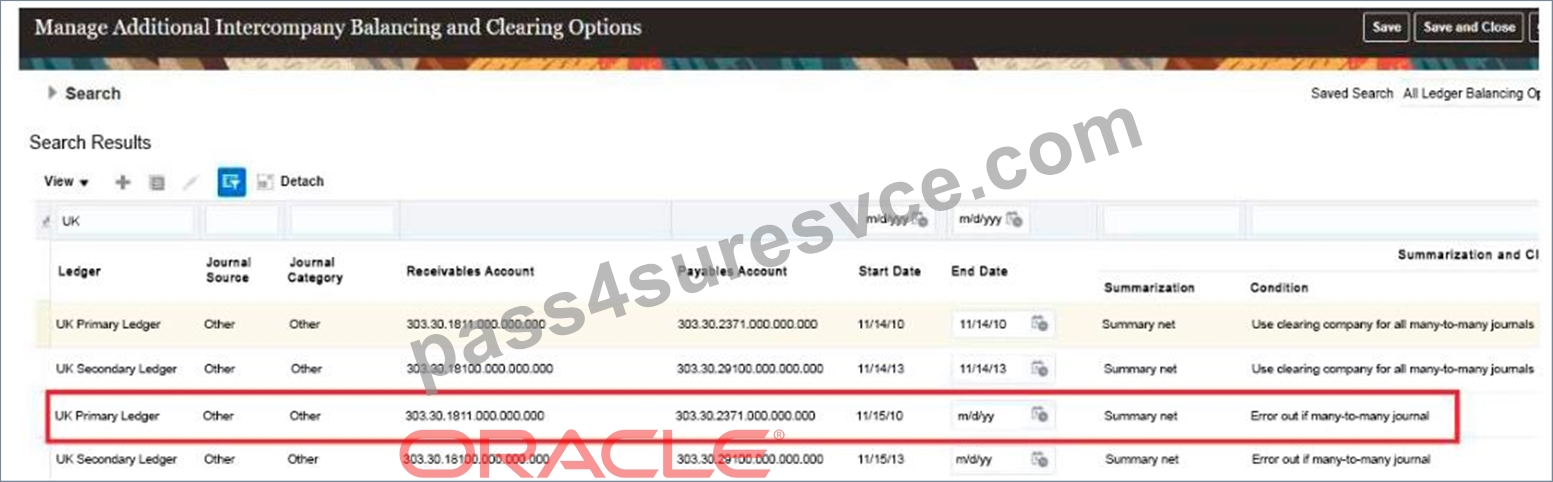
- A. when the journal is balanced by the primary BSV but not by second or third BSV
- B. when the journal is not balanced by the primary balancing segment value (BSV)
- C. when the journal is balanced by second balancing segment value
- D. when there is a many-to-many journal and you want to use a clearing company
Answer: A
Explanation:
Intercompany processing will balance a journal using the accounts identified here for the UK Ledger when the journal is balanced by the primary balancing segment value (BSV) but not by second or third BSV. A BSV is a segment in the chart of accounts that identifies a legal entity or business unit for which financial statements are prepared and balanced. A primary BSV is required for every ledger and is used to balance journal entries within a ledger. A secondary or tertiary BSV is optional and is used to balance journal entries across different dimensions other than the primary BSV, such as fund or region. Intercompany processing is a feature that enables intercompany transactions between different legal entities or business units within the same enterprise. Intercompany processing uses intercompany balancing rules to generate intercompany receivables and payables accounts for cross-ledger or cross-BSV journals. Intercompany processing will balance a journal using the accounts identified here for the UK Ledger when the journal is balanced by the primary BSV but not by second or third BSV, as this indicates that there is an intercompany transaction between different legal entities or business units within the UK Ledger that requires intercompany balancing. Intercompany processing will not balance a journal using the accounts identified here for the UK Ledger when there is a many-to-many journal and you want to use a clearing company, as this is a scenario that involves multiple legal entities or business units across different ledgers that requires a separate clearing company ledger to perform intercompany balancing. Intercompany processing will not balance a journal using the accounts identified here for the UK Ledger when the journal is not balanced by the primary BSV, as this is an invalid scenario that violates the accounting rules and prevents posting of the journal. Intercompany processing will not balance a journal using the accounts identified here for the UK Ledger when the journal is balanced by second balancing segment value, as this is an incomplete scenario that does not specify whether the journal is also balanced by primary and third BSV. Reference: Oracle Financials Cloud: General Ledger 2022 Implementation Professional Objectives - Configure and Process Intercompany 12
NEW QUESTION # 66
You are creating values for the chart of account value set that you are planning to use for the account segment within your Chart of Accounts.
You are not able to assign an Account Type. What is the reason for this?
- A. You have not set the Allow Budgeting attribute for the value set
- B. You are creating values before assigning the value set to the structure
- C. The Account Type qualifier has not been enabled when defining the value set
- D. You have not set the Allow Posting attribute for the value set
Answer: B
Explanation:
According to Oracle documentation1, the reason why you are not able to assign an Account Type when creating values for the chart of account value set is that you are creating values before assigning the value set to the structure. The Account Type attribute is only available after you assign the value set to a chart of accounts structure instance. The Account Type attribute determines how an account is used and reported in General Ledger. Therefore, option C is correct. Option A is incorrect because you do not need to set the Allow Budgeting attribute for the value set to assign an Account Type. Option B is incorrect because the Account Type qualifier does not need to be enabled when defining the value set to assign an Account Type. Option D is incorrect because you do not need to set the Allow Posting attribute for the value set to assign an Account Type.
NEW QUESTION # 67
You defined a tree or hierarchy, but you are unable to set its status to Active. What is the reason?
- A. An Audit process needs to be successfully performed before a tree version can be set to Active
- B. Two tree versions were not defined
- C. Chart of accounts was not deployed
- D. Accounting Configuration was not submitted
Answer: A
Explanation:
https://docs.oracle.com/cd/E51367_01/financialsop_gs/OAACT/F1005378AN156C9.htm The reason why you are unable to set a tree or hierarchy status to Active is that an Audit process needs to be successfully performed before a tree version can be set to Active. The Audit process validates the tree structure and checks for errors or inconsistencies. If the Audit process fails, you need to correct the errors and run the Audit process again until it succeeds. Then you can set the tree version status to Active. The number of tree versions does not affect the ability to set a tree status to Active, as long as there is at least one tree version defined. Accounting Configuration does not need to be submitted before setting a tree status to Active, as this is a separate task that involves submitting all accounting configuration changes for deployment. Chart of accounts does not need to be deployed before setting a tree status to Active, as this is a separate task that involves deploying flexfield metadata changes for validation and activation. Reference: Oracle Financials Cloud: General Ledger 2022 Implementation Professional Objectives - Define Chart of Accounts 12
NEW QUESTION # 68
All of your subsidiaries reside on the same application instance, but some of them require a different chart of accounts and/or accounting calendar and currency. There is no minority interest or partial ownerships. What is Oracle's recommended approach to performing consolidations?
- A. Translate balances to the corporate currency for ledgers not in the corporate currency, use General Ledger's Financial Reporting functionality to produce consolidated reports by balancing segment where each report represents a different subsidiary.
- B. Create separate ledgers for each subsidiary that shares the same chart of accounts, calendar, currency, and accounting method. Create a separate elimination ledger to enter intercompany eliminations. Then creates a ledger set across all ledgers and report on the ledger set.
- C. Translate balances to the corporate currency, create a chart of accounts mapping to the corporate chart of accounts, then transfer balances to the corporate consolidation ledger using the balance transfer program
- D. Use Oracle Hyperion Financial Management for this type of complex consolidation.
Answer: C
NEW QUESTION # 69
You need to create a boardroom ready month-end reporting package for an upcoming Audit Committee meeting. You have 10 Financial Reports that you want to share with executives and auditors that are nicely formatted.
What are the two Oracle recommended ways to accomplish this? (Choose two.)
- A. Create a Smartview report, where the various sheets represent the different Financial Statements and send them the spreadsheet
- B. Use a report batch to run reports at a specific time to create a set of snapshot reports
- C. Using Workspace, assemble multiple reports into a book that can be printed and viewed individually as an entire book
- D. Use BI Publisher to configure the reports and then use bursting to email the reports to the executives and Audit Committee
- E. Use OTBI to create multiple reports that you save to a folder that only the users can access
Answer: B,C
Explanation:
According to Oracle documentation1, the two Oracle recommended ways to create a boardroom ready month-end reporting package for an upcoming Audit Committee meeting are using Workspace and using a report batch. Workspace enables you to assemble multiple reports into a book that can be printed and viewed individually or as an entire book. A report batch enables you to run reports at a specific time to create a set of snapshot reports. Therefore, options B and D are correct. Option A is incorrect because BI Publisher is not a tool to create financial reports. Option C is incorrect because Smartview is not a tool to create financial reports. Option E is incorrect because OTBI is not a tool to create financial reports.
NEW QUESTION # 70
You operate in a country whose unstable currency makes it unsuitable for managing your day-to-day business. As a consequence, you need to manage your business in a more stable currency while retaining the ability to report in the unstable local currency. What would be your recommendation when defining ledgers?
- A. Use Journal-Level or Subledger-Level Reporting Currencies denominated in the more stable currency
- B. Create a secondary ledger that uses a different chart of accounts that is denominated in the more stable currency
- C. Run Revaluation as often as you need to the more stable currency and report on the more stable currency's balances
- D. Run Revaluation to translate into Statistical Currency
Answer: A
Explanation:
The recommendation when defining ledgers for a country whose unstable currency makes it unsuitable for managing your day-to-day business is to use Journal-Level or Subledger-Level Reporting Currencies denominated in the more stable currency. Reporting currencies are representations of a primary or secondary ledger in another currency that share the same chart of accounts, accounting calendar, and accounting method as their related ledger. You can use reporting currencies for online inquiries, reporting, and consolidation. Journal-Level or Subledger-Level Reporting Currencies capture transactional balances at the journal or subledger level and convert them to the reporting currency using daily rates. This allows you to manage your business in a more stable currency while retaining the ability to report in the unstable local currency. You do not need to run Revaluation as often as you need to the more stable currency and report on the more stable currency's balances, as this is a process that adjusts foreign currency balances to reflect current exchange rates, not a way to define ledgers. You do not need to run Revaluation to translate into Statistical Currency, as this is not a supported option. You do not need to create a secondary ledger that uses a different chart of accounts that is denominated in the more stable currency, as this is an optional ledger that is linked to a primary ledger for the purpose of tracking alternative accounting representations of the same transactions. Reference: Oracle Financials Cloud: General Ledger 2022 Implementation Professional Objectives - Consolidate Balances 12
NEW QUESTION # 71
You need to set up a calendar for fiscal year Apr-XX to March-YY where YY is the following year, and you would like the periods to be named according to the year they fall in.
What Calendar format should you choose?
- A. Period
- B. Fiscal
- C. Year
- D. Calendar
Answer: B
Explanation:
According to Oracle documentation, when you need to set up a calendar for fiscal year Apr-XX to March-YY where YY is the following year, and you would like the periods to be named according to the year they fall in, you should choose Fiscal as the Calendar format. A Fiscal calendar format enables you to define periods based on fiscal years that span two calendar years. Therefore, option B is correct. Option A is incorrect because a Calendar format defines periods based on calendar years that start on January 1st and end on December 31st. Option C is incorrect because a Year calendar format defines periods based on calendar years that start on any month other than January and end on any month other than December. Option D is incorrect because a Period calendar format defines periods based on any number of days or weeks.
NEW QUESTION # 72
Your customer wants to create fully balanced balance sheets for the Company, Line of Business, and Product segments for both financial and management reporting.
What is Oracle's recommended method for doing this?
- A. Create a segment that acts as the primary balancing segment and create values that represent a concatenation of all three business dimensions
- B. Create two segments where the first segment represents the concatenation of Company and Line of Business, and then enable secondary tracking for the Product segment
- C. Create three segments for the Company, Line of Business, and Product segments and qualify them as primary balancing segment, second, and third balancing segments, respectively
- D. Use account hierarchies to create different hierarchies for different purposes and use those hierarchies for reporting
Answer: C
Explanation:
This is the recommended method for creating fully balanced balance sheets for multiple segments. By qualifying the segments as balancing segments, you can ensure that each segment value has a balanced set of asset, liability, and equity accounts. You can also use segment value security rules to restrict access to segment values based on user roles. This method also allows you to use different currencies for each segment value and perform currency translation at the segment level. Reference: Oracle Financials Cloud: General Ledger 2022 Implementation Professional Objectives - Configure Enterprise and Financial Reporting Structures - Define Chart of Accounts Segments 12
NEW QUESTION # 73
Your customer has three legal entities, 50 departments, and 10,000 natural accounts. They use intercompany entries. What is Oracle's recommended practice when implementing a new chart of accounts? How many segments and what segment qualifiers should be used?
- A. Define five segments for the company, department, natural account, intercompany, and future use segment. The qualifiers should be primary balancing segment, cost center segment, natural account segment, intercompany segment, and no qualifier, respectively.
- B. Define four segments for the company, department, natural account, and intercompany segment. The qualifiers should be primary balancing segment, cost center segment, and natural account segment, and intercompany segment, respectively.
- C. Define three segments for the company, department, and natural account. The qualifiers for the first segment should be primary balancing segment and intercompany segment, cost center segment, and natural account segment, respectively.
- D. Define three segments for the company, department, and natural account. The qualifiers should be primary balancing segment, cost center segment, and natural account segment, respectively.
Answer: A
Explanation:
"A chart of accounts segment is a component of the account combination. Each segment has a value set attached to it to provide formatting and validation of the set of values used with that segment." The qualifiers are used to identify the segments for reporting and processing purposes2. In this case, the company segment should be the primary balancing segment, which is used to balance journal entries and create trial balances. The department segment should be the cost center segment, which is used to track costs by organizational units. The natural account segment should be the natural account segment, which is used to classify transactions by account type. The intercompany segment should be the intercompany segment, which is used to identify transactions between different legal entities or business units.
NEW QUESTION # 74
You are defining an income statement report using Financial Reporting Studio. Users of the report need to be able to analyze the balances directly from the report.
What should you enable to allow this?
- A. Drill Through in Grid Properties
- B. Nothing. All report are drillable
- C. Drill Down in Report Functions
- D. Allow Expansion in Report Functions
Answer: C
Explanation:
Reference:
html#FAUGL1192194
NEW QUESTION # 75
Which delivered role can access the full functionality of Functional Setup Manager?
- A. Application Implementation Consultant
- B. Any functional user
- C. Functional Setup Manager Superuser
- D. IT Security Manager
- E. Application Implementation Manager
Answer: E
Explanation:
According to Oracle documentation2, the delivered role that can access the full functionality of Functional Setup Manager is Application Implementation Manager. Functional Setup Manager is a tool that enables you to manage and perform all of the setup tasks required for an application implementation. Application Implementation Manager is a predefined role that grants access to Functional Setup Manager and all of its features, such as setup tasks, implementation projects, setup export and import, and setup reports. Therefore, option A is correct. Option B is incorrect because Functional Setup Manager Superuser is not a delivered role. Option C is incorrect because IT Security Manager is a role that grants access to security-related tasks, not Functional Setup Manager. Option D is incorrect because any functional user does not have access to Functional Setup Manager by default. Option E is incorrect because Application Implementation Consultant is not a delivered role.
NEW QUESTION # 76
You can run predefined reports to reconcile subledger application balances to General Ledger balances.
Which attribute needs to be set up on the Manage Values page for chart of accounts segment values so that you can run the Payables to General Ledger Reconciliation Report or Receivables to General Ledger Reconciliation Report?
- A. Financial Category
- B. End Date
- C. Third Party Control Account
- D. Reconcile
- E. Start Date
Answer: C
Explanation:
According to Oracle documentation3, the attribute that needs to be set up on the Manage Values page for chart of accounts segment values so that you can run the Payables to General Ledger Reconciliation Report or Receivables to General Ledger Reconciliation Report is Third Party Control Account. The Third Party Control Account attribute enables you to maintain detailed balances by third party for an account combination. Valid third-party information must be associated with the journal line if the account is a third party control account. General Ledger prevents manual journal entries from posting to third party control accounts. Therefore, option B is correct. Option A is incorrect because Financial Category is not an attribute that affects the reconciliation reports. Option C is incorrect because End Date is not an attribute that affects the reconciliation reports. Option D is incorrect because Start Date is not an attribute that affects the reconciliation reports. Option E is incorrect because Reconcile is not an attribute that affects the reconciliation reports.
NEW QUESTION # 77
Your customer requires physical invoices to be generated in Payables Cloud and Receivables Cloud for the Intercompany payables and receivables transactions. Which two statements are correct with regards to setting this up? (Choose two.)
- A. You only need to assign the Legal Entity and Organization Contact
- B. You must assign the corresponding Receivables and Payables Business Units
- C. You must have implemented Payables Cloud and Receivables Cloud
- D. You can only associate one Intercompany Organization per Legal Entity
Answer: B,C
NEW QUESTION # 78
You want to automatically post journal batches imported form subledger sources to prevent accidental edits or deletions of the subledger sources journals, which could cause an out-of-balance situation between your subledgers and general ledger. Which two aspects should you consider when defining your AutoPost Criteria? (Choose two.)
- A. Include all of your subledger sources in the AutoPost CriteriA. Divide up criteria sets by subledger source only if you need to schedule different posting times
- B. Schedule your AutoPost Criteria set to run during off-peak hours only
- C. Create your AutoPost criteria using minimal sources and categories
- D. Use the All option for category and accounting period to reduce maintenance and ensure that all imported journals are included in the posting process
Answer: A,D
Explanation:
According to Oracle documentation2, when defining your AutoPost Criteria to automatically post journal batches imported from subledger sources, you should consider the following aspects: Use the All option for category and accounting period to reduce maintenance and ensure that all imported journals are included in the posting process, and include all of your subledger sources in the AutoPost Criteria. Divide up criteria sets by subledger source only if you need to schedule different posting times. Therefore, options A and C are correct. Option B is incorrect because you should create your AutoPost criteria using as many sources and categories as needed. Option D is incorrect because you can schedule your AutoPost Criteria set to run at any time, not only during off-peak hours.
NEW QUESTION # 79
Which tool can you use to create a Financial Income Statement?
- A. PS/nVision
- B. Rapid Implementation Enterprise Structures setup
- C. One View Reporting
- D. Account Inspector
Answer: D
NEW QUESTION # 80
......
1z0-1054-22 Exam Dumps Pass with Updated 2023 Certified Exam Questions: https://realpdf.pass4suresvce.com/1z0-1054-22-pass4sure-vce-dumps.html